When people talk about the explosion of deep learning and AI since 2015, one name almost always comes up first: TensorFlow. Released by Google in November 2015 as an open-source machine learning framework, TensorFlow quickly became the de facto standard for building, training, and deploying neural networks at scale.
Even in 2026 — with PyTorch dominating research papers and JAX gaining traction in high-performance computing — TensorFlow remains one of the most widely deployed frameworks in production environments worldwide. From mobile apps to massive cloud clusters, TensorFlow powers real-world AI every day.
A Brief History: From Google Brain to Ecosystem Leader
- 2015 — TensorFlow 0.5 released under Apache 2.0 license. Google open-sources what was originally an internal tool (DistBelief successor).
- 2017 — TensorFlow 1.0 → production stability, Keras integration as official high-level API.
- 2019 — TensorFlow 2.0 → eager execution by default, massive API cleanup, end-to-end Keras focus.
- 2020–2022 — TensorFlow Lite (mobile/edge), TensorFlow.js (browser), TensorFlow Quantum (hybrid quantum-classical), TFX (end-to-end MLOps).
- 2023–2026 — TensorFlow 2.10+ series: better multi-GPU/TPU support, improved XLA compilation, tighter integration with Keras 3 (multi-backend), native support for newer hardware (AMD ROCm, Apple Silicon Metal, Intel oneAPI), and growing GenAI tooling (transformers, diffusion models, LLM fine-tuning helpers).
Today TensorFlow is maintained by Google and a huge open-source community — with more than 200,000 GitHub stars and millions of monthly downloads.
Core Strengths of TensorFlow in 2026
| Strength | What It Means in Practice | Why It Still Wins in Production |
|---|---|---|
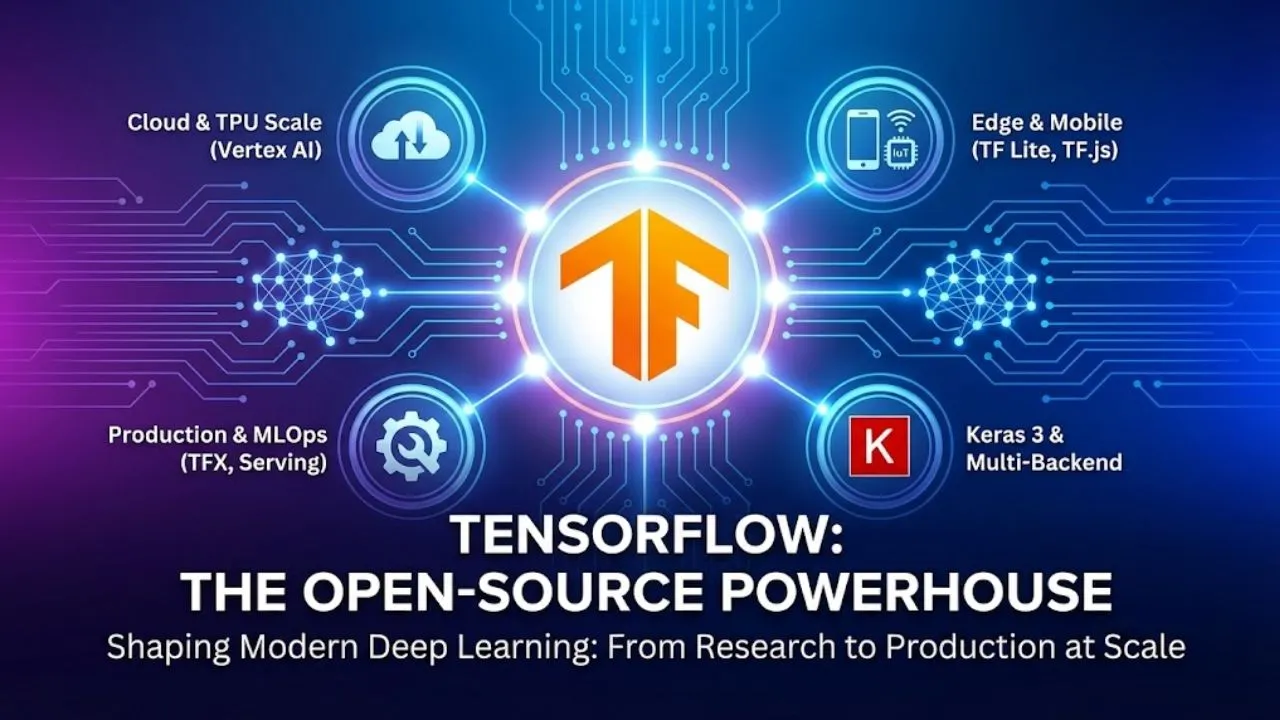
| Production-First Design | TFX (TensorFlow Extended), TensorFlow Serving, TensorFlow Lite, TensorFlow.js | Trusted for large-scale, regulated deployments |
| Keras 3 | Single API that runs on TensorFlow, PyTorch, JAX backends | Write once, deploy anywhere |
| Ecosystem Depth | TFX, TensorBoard, TensorFlow Hub, TensorFlow Datasets, TensorFlow Probability, TF-DF | Full MLOps + research in one stack |
| Hardware Acceleration | Native TPU support, XLA compiler, CUDA/ROCm/Metal/DirectML, oneDNN optimizations | Best-in-class performance on Google Cloud TPUs |
| Edge & Mobile | TensorFlow Lite Micro, TensorFlow Lite for Microcontrollers, delegate support (GPU/NPU) | Runs on phones, IoT, embedded devices |
| Browser & JavaScript | TensorFlow.js — train & infer directly in the browser or Node.js | Web-based AI apps, interactive demos |
| Explainability & Privacy | TF Privacy (DP-SGD), TF Encrypted, What-If Tool, Model Card Toolkit | Critical for finance, healthcare, government |
Real-World Use Cases in 2026
- Recommendation Systems — YouTube, Google Play, Spotify-like personalization at scale
- Computer Vision — Google Photos (object detection, face clustering), Waymo (perception stack)
- Natural Language Processing — Google Translate backend, BERT/T5 fine-tuning pipelines
- Healthcare — Medical image segmentation, predictive diagnostics, federated learning on patient data
- Finance — Fraud detection, algorithmic trading, credit risk models with strong governance
- Manufacturing & IoT — Predictive maintenance, anomaly detection on factory sensor streams
- Mobile & Edge AI — On-device speech recognition, live filters, OCR in camera apps
- Scientific Research — Climate modeling, protein folding support, quantum ML experiments
Quick Code Example (TensorFlow + Keras 3 in 2026 Style)
Python
import tensorflow as tf
from tensorflow import keras
from tensorflow.keras import layers

# Simple CNN for image classification (MNIST example)
model = keras.Sequential([
    layers.Input(shape=(28, 28, 1)),
    layers.Conv2D(32, 3, activation='relu'),
    layers.MaxPooling2D(),
    layers.Conv2D(64, 3, activation='relu'),
    layers.MaxPooling2D(),
    layers.Flatten(),
    layers.Dense(128, activation='relu'),
    layers.Dropout(0.5),
    layers.Dense(10, activation='softmax')
])

model.compile(
    optimizer='adam',
    loss='sparse_categorical_crossentropy',
    metrics=['accuracy']
)

# Load and prepare data
(x_train, y_train), (x_test, y_test) = keras.datasets.mnist.load_data()
x_train = x_train[..., tf.newaxis].astype("float32") / 255.0
x_test  = x_test[..., tf.newaxis].astype("float32")  / 255.0

# Train
model.fit(x_train, y_train, epochs=10, validation_data=(x_test, y_test))

# Export to SavedModel (for serving)
model.export("mnist_model")
Why TensorFlow Remains a Top Choice in 2026
- Unmatched production maturity — battle-tested at planetary scale
- Keras 3 multi-backend — write code once, run on TF, PyTorch, or JAX
- Google ecosystem synergy — TPUs, Vertex AI, BigQuery ML, Colab, TensorFlow Extended
- Edge-to-cloud continuum — same model code runs from microcontrollers → browser → TPU pod
- Strong governance story — lineage tracking, model cards, differential privacy tools
Read Also: PyTorch: The Pythonic Powerhouse Driving Modern Machine Learning and Deep Learning
Final Verdict
TensorFlow is no longer “the Google framework” — it’s the production-grade backbone of serious AI deployments. If your team needs to ship reliable, scalable, auditable models — especially in regulated industries or at massive scale — TensorFlow (with Keras 3) is still one of the safest, most complete choices available.