

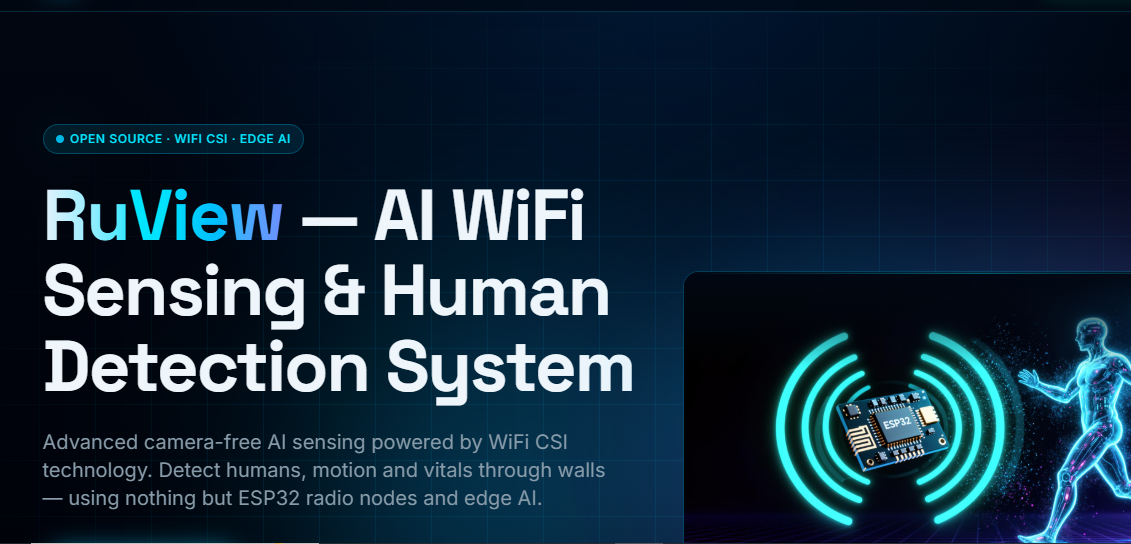
RuView has become one of the most talked-about open-source projects in the wireless sensing community. The project claims to transform ordinary WiFi signals into a powerful sensing system capable of detecting human presence, monitoring breathing, tracking movement, and even estimating body pose without cameras or wearable devices. Built around ESP32 hardware and WiFi Channel State Information (CSI), RuView aims to bring advanced spatial intelligence to developers, researchers, and smart-home enthusiasts.
But does RuView actually work, or is it simply another viral GitHub project with ambitious promises?
In this detailed review, we will explore what RuView is, how it works, its features, hardware requirements, real-world applications, strengths, limitations, and whether it is worth your time.
What Is RuView?
RuView is an open-source WiFi sensing platform developed by ruvnet. Instead of relying on cameras, infrared sensors, or wearable devices, it analyzes WiFi signal disturbances to detect and understand human activity within an environment. The platform uses WiFi Channel State Information (CSI), a detailed representation of how wireless signals travel through space and interact with objects and people.
The concept is based on years of academic research showing that human movement affects WiFi signals in measurable ways. By processing these changes with signal-processing algorithms and machine learning models, RuView attempts to infer presence, motion, breathing patterns, occupancy, and body posture.
Key Features of RuView
1. Presence Detection
RuView can determine whether someone is inside a room without requiring a camera or wearable device. This feature can be useful for smart homes, office occupancy monitoring, and energy-saving automation.
2. Motion Tracking
The platform continuously monitors WiFi signal fluctuations to identify movement within a monitored area. Motion detection works even in low-light conditions where cameras would struggle.
3. Breathing and Vital Sign Monitoring
One of RuView’s most ambitious features is contactless monitoring of breathing and heart rate using CSI data collected from ESP32 sensors. The project includes firmware specifically designed to capture signal variations associated with respiration and heartbeat.
4. Through-Wall Sensing
The project gained widespread attention because of its claim that WiFi signals can be used to detect people through walls. While the underlying physics is supported by academic research, practical performance depends heavily on hardware configuration, room layout, and signal quality.
5. Smart Home Integration
RuView supports integration with Home Assistant, Apple Home, Google Home, Amazon Alexa, and Matter-compatible ecosystems, allowing sensor data to be used for home automation workflows.
6. Privacy-First Design
Unlike camera-based monitoring systems, RuView does not capture visual information. This makes it appealing for environments where privacy is important, such as bedrooms, hospitals, elder-care facilities, and workplaces.
Hardware Requirements
RuView supports multiple hardware configurations, but the recommended setup consists of:
- 3 to 6 ESP32-S3 development boards
- Existing WiFi router
- Raspberry Pi or PC acting as an aggregator
- Optional Cognitum Seed module for advanced AI capabilities
A basic starter setup can reportedly be assembled for approximately $54 using ESP32 boards and existing networking equipment.
The project documentation emphasizes that advanced sensing features require CSI-capable hardware. Standard laptops and smartphones generally provide only RSSI measurements, which are insufficient for pose estimation and vital-sign monitoring.
How RuView Works
The sensing pipeline follows several stages:
- ESP32 nodes capture WiFi Channel State Information.
- CSI data is transmitted over the network.
- A host system processes the incoming signal data.
- Machine learning models analyze patterns.
- Results are visualized through dashboards or integrated into automation systems.
This architecture allows most processing to occur locally, reducing privacy concerns and minimizing cloud dependency.
Real-World Applications
Smart Homes
- Occupancy detection
- Automated lighting
- Energy optimization
- Security monitoring
Healthcare
- Elderly activity monitoring
- Fall detection
- Sleep monitoring
- Breathing analysis
Commercial Buildings
- Meeting room occupancy
- Visitor analytics
- Building automation
Emergency Response
Researchers have suggested that WiFi sensing technologies could eventually assist in search-and-rescue operations by detecting movement behind obstacles or debris.
Community Feedback
RuView has received both praise and criticism from the developer community.
Supporters argue that WiFi CSI sensing is a well-established research field and that RuView provides a practical open-source framework for experimentation. Several users report successful presence detection and motion tracking using ESP32 hardware.
Critics, however, point out that some of the project’s most impressive claims—particularly full pose estimation and advanced through-wall sensing—have not yet been independently validated at scale. Some developers describe the repository as experimental and caution users against expecting production-ready performance.
Pros
Open Source
The entire platform is publicly available, allowing developers to inspect, modify, and extend the codebase.
Low-Cost Hardware
ESP32 boards are affordable and widely available, making experimentation accessible to hobbyists and researchers.
Privacy Friendly
No cameras are required, reducing concerns about visual surveillance.
Edge Computing
Most processing can run locally without cloud services.
Active Development
The repository continues to receive updates, documentation improvements, firmware releases, and community contributions.
Cons
Complex Setup
Deploying a full CSI sensing system requires specialized hardware and networking knowledge.
Experimental Technology
Many features remain research-oriented and may not work consistently in all environments.
Limited Independent Validation
Some headline claims have generated skepticism because reproducible public demonstrations remain limited.
Hardware Dependency
Advanced functionality requires CSI-compatible hardware, which is not available on most consumer devices.
RuView vs Traditional Sensors
| Feature | RuView | Camera | PIR Sensor |
|---|---|---|---|
| Privacy | Excellent | Poor | Good |
| Through-Wall Detection | Possible | No | No |
| Pose Estimation | Experimental | Excellent | No |
| Cost | Low | Medium | Very Low |
| Lighting Dependency | None | High | None |
| Vital Sign Monitoring | Experimental | Limited | No |
Is RuView Worth Trying?
If you are a developer, researcher, IoT enthusiast, or smart-home builder interested in wireless sensing technology, RuView is absolutely worth exploring. It provides one of the most ambitious open-source implementations of WiFi CSI sensing currently available.
However, users should approach the project with realistic expectations. Presence detection and motion sensing appear to be achievable with the documented hardware setup, while more advanced capabilities such as precise pose estimation, heartbeat monitoring, and reliable through-wall tracking still require further validation and experimentation.
Final Verdict
RuView is one of the most innovative open-source projects of 2026. It demonstrates how ordinary WiFi signals can potentially become a powerful sensing medium for smart homes, healthcare, security, and research applications. While some claims remain controversial and the platform is still evolving, the underlying science of WiFi CSI sensing is legitimate and supported by years of academic work.
For developers looking to experiment with next-generation sensing technology, RuView offers an exciting platform that combines low-cost hardware, privacy-first monitoring, and edge AI. Just remember that it is currently best viewed as an advanced research and prototyping platform rather than a finished commercial product.